
 rgpot
Measure CPU scaling of batch evaluation
scripts/cpu_scaling.py times evaluate_batch at each thread count.
It writes three tables as CSV.
It runs only when called, and it changes nothing in the library.
strong.csvkeeps the batch fixed and adds threads.onecell.csvgives one large periodic cell to every thread count.weak.csvgives every thread the same number of cells.
Each sample is one whole evaluate_batch call from Python.
That covers the input copies, one potential per worker and the pairs.
It also covers starting and joining the threads and the output arrays.
After every call the energy and forces are compared bit for bit.
The reference is a 1-thread call on the same cells.
The match column records the result.
Run it
Build with meson and make the rgpot package importable.
One way is meson install with --destdir.
The harness reads the compiler and the build options from the build.
It finds them in the meson-info directory.
python scripts/cpu_scaling.py --build-dir build --out results \
    --plot cpu_scaling.png
--threads picks the thread counts, and 1 is always added.
--repeats sets the timed calls per row, and it must be at least six.
The exit status is 1 when any row does not match the 1-thread call.
Read the tables
Every file starts with # lines.
They give uname -m and the CPU model from lscpu.
The core count comes from env -u OMP_NUM_THREADS nproc.
The compilers and the build options follow.
The last lines give the Python, NumPy and rgpot versions and the device.
The columns median_s, q1_s and q3_s are the quartiles.
iqr_s is q3_s minus q1_s.
The quartiles use the inclusive method of statistics.quantiles.
It interpolates linearly, as the NumPy default does.
In the strong and one-cell tables, speedup is the 1-thread median.
It is divided by the median of the row.
efficiency is speedup over the thread count.
In the weak table, efficiency is the 1-thread median over the median.
There speedup is efficiency times the thread count.
That is the throughput ratio.
The constants
The cells are Pt fcc with a lattice parameter of 3.92 Angstrom. It is in Kittel, Introduction to Solid State Physics, 8th ed., chapter 1. The
pt-bulksystem oftime_pair_scalinguses the same value.The potential is
MorsePotwith its platinum defaults. So the call takes the linkcell and minimage pair list. Nothing is tuned for this system.A batch cell is 5 x 5 x 5 conventional cells, 500 atoms. Its edge of 19.6 Angstrom is more than twice the 9.5 Angstrom cutoff. Minimum image needs that, and four repeats would be too small.
The one-cell table uses 14 x 14 x 14 cells, 10976 atoms. Fourteen is the smallest repeat with at least 104atoms. That is the size of the bulk cell in
tests/python/test_scaling.py.Sites move by normal deviates of standard deviation 0.015 Angstrom. Cell
iuses the seed1000 + i. Both choices follow the Pt7 frames oftest_scaling.py. A perfect lattice would give zero forces and a weak comparison.Each worker gets 8 cells. On the host below, a width-8 call on two-atom cells cost 148 us. One 500-atom cell cost 0.69 ms on one thread. Eight is the smallest power of two that keeps 148 us under 5 percent. The 5 percent is the noise floor in
benchflow/export_results.py. The strong batch is 8 times the largest thread count. So the widest strong row and the widest weak row run the same cells.The thread counts are the powers of two up to the core count. The core count itself is added when it is not a power of two.
Seven timed calls per row is the smallest odd count of at least six. So the median is one of the samples. One more untimed round runs first, as the asv warm-up does. In a fresh process the first 10976-atom call took 140 ms. Later calls took about 9 ms. The thread counts are interleaved within each round. So drift on the host spreads over every row.
Results on one host
The host was an 8-core x8664virtual machine under KVM.
lscpu names the CPU Intel(R) Xeon(R) Processor, one thread per core.
The build was a release build with GCC 13.3.0.
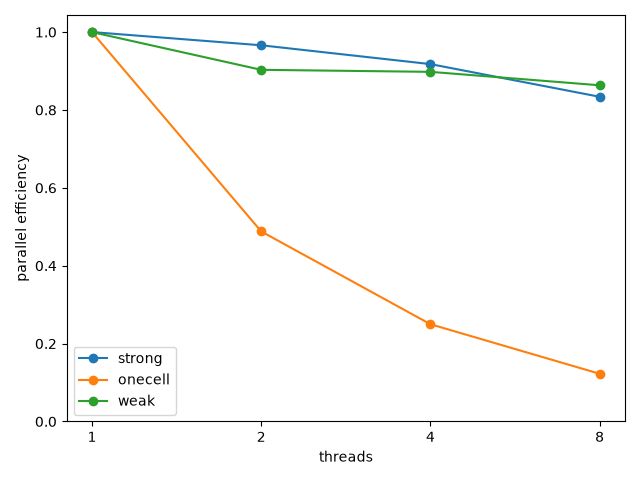
Parallel efficiency against thread count, from one run of scripts/cpu_scaling.py on the 8-core host.
The strong batch of 64 cells took 44.2 ms on one thread.
On eight threads it took 6.63 ms, an efficiency of 0.83.
The weak rows stayed between 5.69 and 6.59 ms.
That is an efficiency of 0.86 at eight threads.
The one-cell row took about 9.1 ms at every thread count.
BatchEvaluator gives each configuration to one worker.
The binding starts no more workers than there are configurations.
So a single cell does not split.
Every row matched the 1-thread call.
Other devices
The harness looks up its evaluator in the DEVICES mapping.
The key is the --device name, and only cpu is there today.
A GPU backend adds an entry with the same signature.
The tables, the header and the 1-thread comparison stay the same.